

Introduction
Childhood trauma does not end in childhood. It continues to influence how you think, feel, behave, and even how your body functions as an adult.
Research shows that early-life trauma, including abuse, neglect, or chronic stress, can significantly impact mental health, relationships, and physical well-being later in life.
At the same time, modern therapeutic approaches such as hypnotherapy offer a powerful pathway to address trauma at its root, the subconscious mind.
This article explores both:
- The scientific impact of childhood trauma
- How hypnotherapy helps rewire those patterns
Effects of Childhood Trauma on Adult Health

Childhood adversity triggers what is known as toxic stress — a prolonged activation of the body’s stress response system.
Mental Health Outcomes
Studies show that individuals exposed to childhood trauma are significantly more likely to experience:
- Depression
- Anxiety disorders
- PTSD
- Substance abuse
Large-scale research also indicates that childhood trauma can double or triple the risk of psychiatric disorders in adulthood.
Brain Development and Neurobiology
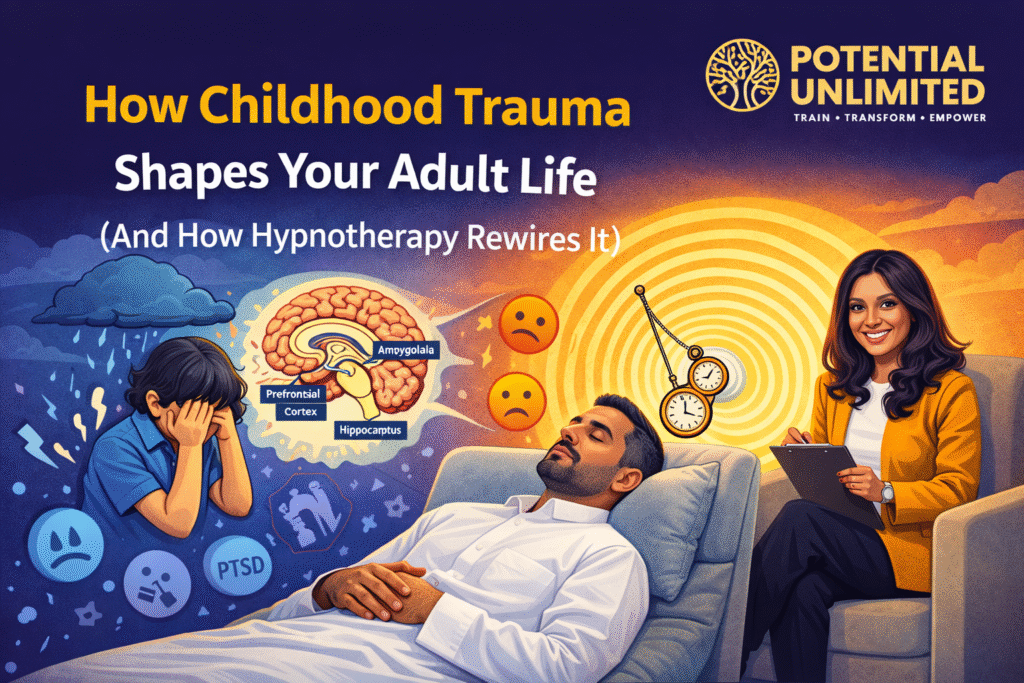
Trauma affects key brain regions:
- Amygdala: Increased fear and threat sensitivity
- Hippocampus: Altered memory processing
- Prefrontal Cortex: Reduced emotional regulation
These changes explain why trauma survivors often struggle with emotional control and heightened stress responses.
Stress System Dysregulation (HPA Axis)
Childhood trauma disrupts the Hypothalamic-Pituitary-Adrenal (HPA) axis, the body’s central stress system.
This leads to:
- Chronically elevated cortisol
- Hormonal imbalance
- Increased physiological stress
Over time, this creates what researchers call allostatic load, contributing to long-term health risks such as cardiovascular disease and metabolic disorders.
Inflammation and Physical Health
Research also links childhood trauma to higher levels of inflammation in adulthood.
Individuals with early-life stress show significantly increased markers such as C-reactive protein, which is associated with:
- Heart disease
- Diabetes
- Chronic illness
Attachment and Relationship Patterns
Childhood trauma strongly influences attachment styles.
Studies show that trauma survivors often develop:
- Anxious attachment
- Avoidant attachment
These patterns lead to:
- Difficulty trusting others
- Fear of rejection
- Emotional withdrawal
Emotional Intelligence Impairment
Trauma also affects emotional intelligence (EQ).
It disrupts brain regions responsible for:
- Self-awareness
- Emotional regulation
- Empathy
As a result, individuals may experience:
- Mood instability
- Emotional numbness
- Difficulty understanding their own emotions
Evidence on Hypnotherapy, NLP, and Emotional Intelligence
Hypnotherapy: Scientific Evidence
Clinical studies show that hypnotherapy is effective in trauma treatment.
- Meta-analysis findings report large reductions in PTSD symptoms
- Effects remain stable over time, including long-term follow-ups
- Hypnosis enables safe access to traumatic memories without overwhelming emotional distress
Neuroscience research shows that hypnosis:
- Modulates attention and emotional processing
- Alters brain connectivity
- Enables new learning patterns
This allows the brain to reprocess trauma and form healthier responses.
NLP (Neuro-Linguistic Programming)
Despite its popularity, current research shows no strong clinical evidence supporting NLP for trauma treatment.
Major clinical reviews confirm that NLP lacks validated results for PTSD, anxiety, or depression.
Emotional Intelligence-Based Approaches
While not a standalone therapy, emotional intelligence development supports healing through:
- Mindfulness
- Emotional regulation techniques
- Behavioral therapy
These approaches help individuals better manage emotional responses and improve relationships.
How Hypnotherapy Rewires the Subconscious
Structure of a Hypnotherapy Program
A typical hypnotherapy program includes 6–8 sessions:
- Intake and relaxation training
- Induction into a trance state
- Deepening focus and awareness
- Trauma processing and reframing
- Positive suggestion and reprogramming
- Integration and reinforcement
What Happens During Therapy
During hypnosis:
- The mind enters a deeply relaxed yet focused state
- Conscious resistance is reduced
- Subconscious patterns become accessible
Therapists use techniques such as:
- Guided imagery
- Memory reframing
- Positive suggestion
This allows individuals to process trauma without fear and create new emotional responses.
8-Week Healing Timeline
- Week 1: Intake and relaxation
- Week 2–3: Induction and initial processing
- Week 4–5: Deep trauma work
- Week 6: Emotional integration
- Week 7: Reinforcement
- Week 8: Review and future planning
Safety and Considerations
Hypnotherapy is considered safe when conducted by trained professionals.
- Individuals remain fully aware and in control
- Side effects are rare and mild
- Not recommended for certain severe psychiatric conditions
Case Study Examples
| Case | Client Background & Symptoms | Trauma History | Hypnotherapy Approach | Outcome (After 6–8 Sessions) |
| Case 1: | 32F with chronic anxiety & panic attacks. | Childhood emotional/physical abuse. | Week1: Assessment & safe place induction. Weeks2–4: Regression to reframe key memories. Weeks5–6: Future pacing (imagining coping confidently). | Achieved 70% reduction in anxiety, no more panic attacks, improved sleep, and confidence. |
| Case 2: | 45M with PTSD (nightmares, hypervigilance). | Combat-related trauma. | Weeks 1–2: Ego-state intro (connecting with younger self), grounding. Weeks 3–5: Trauma processing via imagery & suggestions of safety. | Nightmares ceased, hypervigilance normalized, returned to work comfortably. |
| Case 3: | 28F with severe phobia of water (panic at beaches). | Drowning incident at age 10. | Weeks 1–2: Relaxation & visualization at the pool.
Weeks 3–4: Desensitization under hypnosis (visualizing calm near water). |
Successfully swam without fear; anxiety about water gone; self-esteem improved. |
Conclusion
Childhood trauma can have long-lasting effects on mental, emotional, and physical health. However, these effects are not permanent.
Scientific evidence shows that the brain is capable of change. Through approaches like hypnotherapy, individuals can reprocess trauma, regulate emotions, and build healthier patterns.
Understanding the impact of trauma is the first step.
Rewiring it is the path forward.
Speak with an expert and start your healing journey today
References
The following sources were used in this article:
- Childhood Trauma, the HPA Axis and Psychiatric Illnesses – PMC https://pmc.ncbi.nlm.nih.gov/articles/PMC9120425
- Does Adult Attachment Style Mediate Childhood Maltreatment – PMC https://pmc.ncbi.nlm.nih.gov/articles/PMC5685930
- Frontiers in Psychology – Trauma and Emotional Intelligence https://www.frontiersin.org/journals/psychology/articles/10.3389/fpsyg.2023.1067509/full
- Meta-Analysis on Hypnotherapy for PTSD – https://www.researchgate.net/publication/284609486_A_Meta-Analysis_for_the_Efficacy_of_Hypnotherapy_in_Alleviating_PTSD_Symptoms
- Functional Brain Changes During Hypnosis – PMC https://pmc.ncbi.nlm.nih.gov/articles/PMC8773773/
- NCBI Review on NLP Effectiveness – https://www.ncbi.nlm.nih.gov/books/NBK254048/
- Childhood Trauma and Cortisol Studies, Inflammation and Trauma Research – PMC https://pmc.ncbi.nlm.nih.gov/articles/PMC2703588/
- Mayo Clinic – Hypnosis Safety – https://www.mayoclinic.org/tests-procedures/hypnosis/about/pac-20394405
- Psychology Today – Emotional Intelligence and Healing https://www.psychologytoday.com/us/blog/hidden-wounds/202205/emotional-intelligence-and-healing-hidden-wounds